Top 10 Enterprise Messaging Platforms for Eastern Europe
Updated: 02.06.2026
Some of the most popular enterprise messaging platforms are mentioned below.
Users that searched for Top 10 Enterprise Messaging Platforms for Eastern Europe then also viewed the following software:
See also: Top 10: Enterprise Messaging Platforms for Eastern Europe
Users that searched for Top 10 Enterprise Messaging Platforms for Eastern Europe then also viewed the following software:
See also: Top 10: Enterprise Messaging Platforms for Eastern Europe
2024. Google Chat now supports IFTTT integration
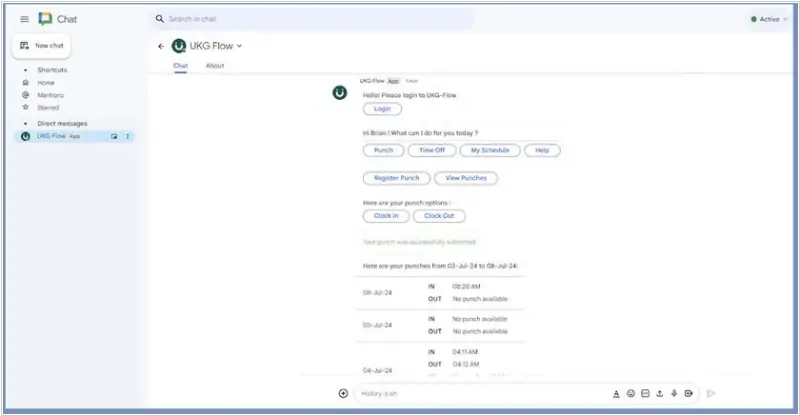
The enterprise messenger Google Chat has added a new integration with IFTTT. You can now set up triggers for new messages, members, or workspaces, and perform actions such as publishing a message or creating a new chat. For example, when adding a new member to a group or uploading a file from Google Drive or Dropbox, you can automatically send an email or message. IFTTT integration is also available for other Google Workspace services, such as Gmail, Drive, and Calendar.
2024. Mattermost now allows you to connect any AI models to chats
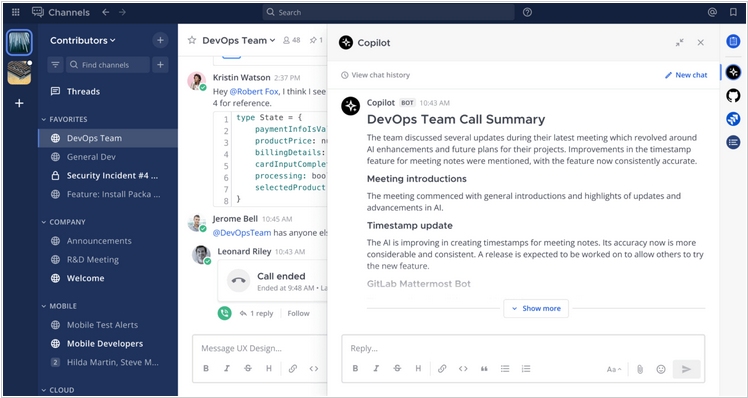
Mattermost, an open-source collaboration platform, has introduced AI model connectivity, which will help government, defense and mission-critical organizations integrate large-scale LLM language models into their communications (via OpenAI-compatible APIs). This will speed up workflows and enable insights from chats, third-party tools, calls, and other data. Mattermost claims that the new tool, called Mattermost Copilot, will enable organizations to leverage AI while maintaining data privacy. The platform also provides a collaborative workspace that can integrate with isolated private clouds and public cloud generative AI services.
2024. Microsoft to remove Teams from Office enterprise subscriptions in Europe
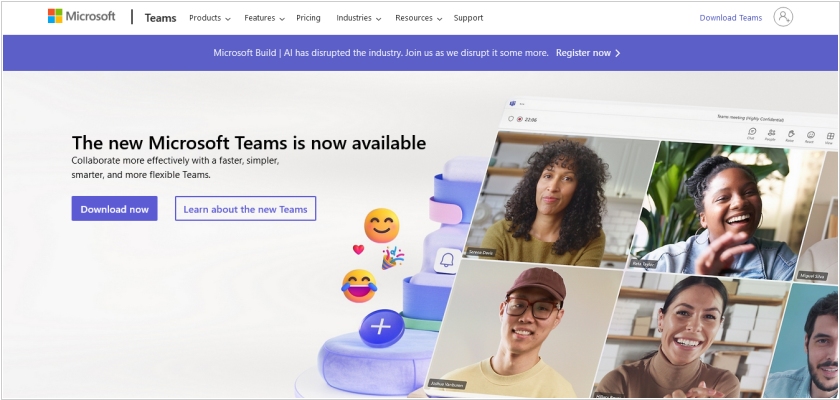
Microsoft will begin selling its corporate messaging app Teams separately from its Office productivity suite worldwide. This comes six months after the company separated the two products in Europe (to avoid a potential antitrust fine from the EU). Customers who received Teams as part of their Microsoft 365 and Office 365 plans can continue to use those plans or switch to plans without Teams. Microsoft 365 offerings for small and medium businesses will include both Teams-equipped and Teams-free options. Consumers and academic license holders will not be affected by this change.
2024. Slack adds AI-fueled search and summarization to the platform

As a leading enterprise communication platform, Slack has somehow managed to become the vast digital attic where all organizational knowledge is stuffed away—dusty, perhaps, but vital. Yet, like any attic, finding what you’re looking for amidst the clutter has proven... tricky. Naturally, Slack, being the sort of forward-thinking platform that wouldn't want you rifling through endless threads for the proverbial needle, has whipped out some shiny new features. Enter: an AI-driven search tool and the ability to magically shrink entire channels into bite-sized chunks of information. This delightful little innovation—channel summarization—means you can now get a pithy summary of your team's ramblings without wading knee-deep in conversation, perfect for those returning from holiday or just trying to make sense of the chaos. You simply ask and Slack’s AI will cheerfully summarize the lot, with a list of handy references to show how it arrived at its conclusions, which, according to Weiss, is a pretty big deal in the grand scheme of things.
2021. Amazon acquired secure enterprise messaging app Wickr
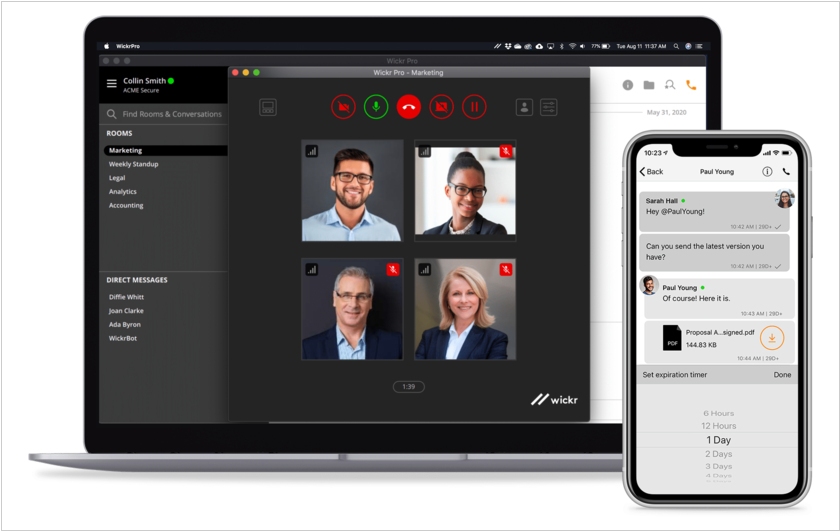
Amazon Web Services, has acquired Wickr, a startup developing a secure messaging app for businesses. It is said to be the only messenger that meets the NSA's security criteria. It supports video calling, video conferencing, file transfer, and integration with corporate systems. Installation on a private server on a local network or use as a SaaS service are possible. Amazon has had its own messenger, Chime, for several years, but it failed to gain much popularity in competition with Slack and Microsoft Teams. Amazon is likely now focusing on increased security.
2020. Salesforce buys Slack for $27.7B

Salesforce, the CRM giant, is acquiring Slack in a $27.7 billion megadeal. The new deal also puts Salesforce more on par — and in competition — with its arch rival and sometime friend Microsoft, whose Teams product has been directly challenging Slack in the market. Microsoft, which passed on buying Slack in the past for a fraction of what Salesforce is paying today, has made Teams a key priority in recent quarters, loathe to cede any portion of the enterprise software market to another company. What really has set Slack apart from the pack, at least initially, was its ability to integrate with other enterprise software. When you combined that with bots, those intelligent digital helpers, the company could potentially provide Salesforce customers with a central place to work without changing focus because everything they need to do can be done in Slack.
2020. Telegram added folders for chats and channels
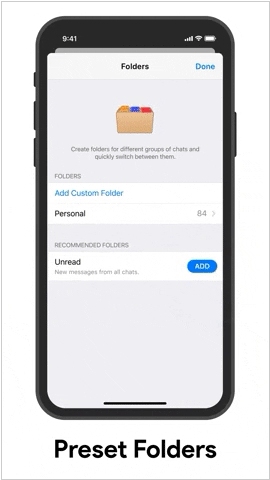
Telegram now allows to group chats and channels into folders. Users can set up their own folders or use the default settings. For example, folders can be used to separate work and family chats. Users can also include or exclude all chats of a certain type, such as "Channels" or "Unread." This feature is activated when the list of conversations becomes too long, or it can be enabled with a special command: it is activated by clicking the link tg://settings/folders. An unlimited number of chats can be pinned to each folder.
2019. Microsoft is intimidating Slack. But Slack isn't afraid.
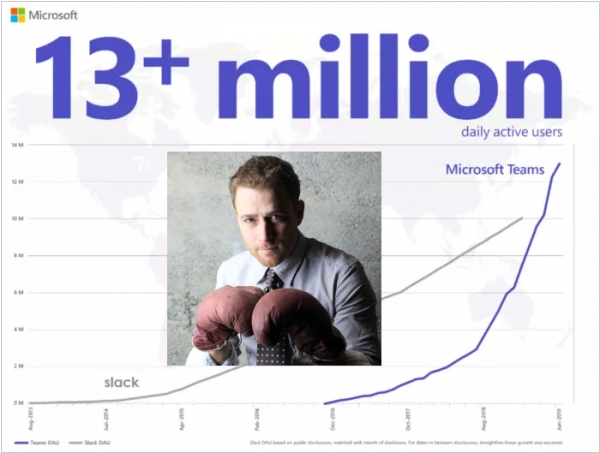
Recently, Microsoft announced that the audience of its enterprise messaging app Microsoft Teams has reached 13 million daily users, which is 3 million more than Slack. They even drew a graph that should scare Slack with this trend. But Slack founder Stewart Butterfield said that there is no reason to worry as long as Slack is more user-friendly. He acknowledges that Teams' active user growth may continue to increase due to the growth of paid subscriptions to Office 365, of which the enterprise messaging app is a part. But, he says, Microsoft has also previously tried to compete with Google search by leveraging the large Windows audience, and it has failed.
2018. Cisco Jabber now supports multi-line architecture
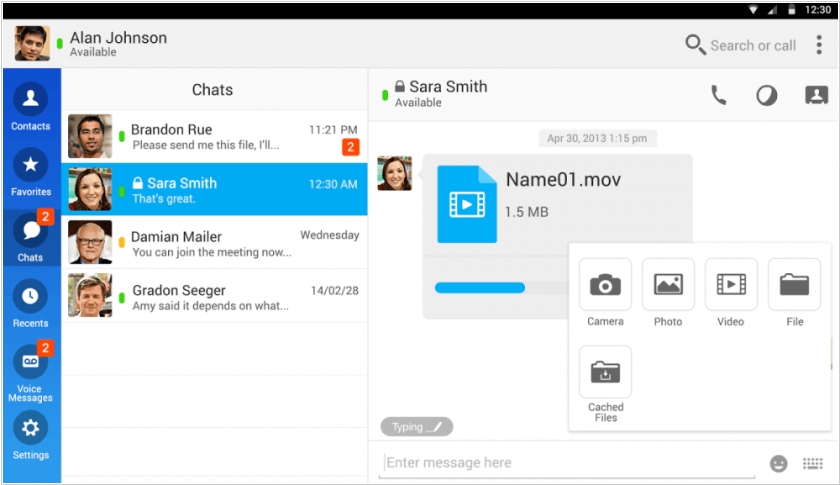
Cisco has added multi-line support to Cisco Jabber 12, its unified communications client for instant messaging and presence. Users can now switch between up to eight phone lines on their softphone and access contact lists even when instant messaging is disabled. Cisco has also integrated Jabber with Android Auto devices, allowing Android users to listen to instant messages in the car and respond to them using voice-to-text input. The release of Jabber 12 underscores the company's continued commitment to supporting client solutions for on-premises deployments, even as it advances its cloud-based team collaboration platform, Cisco Spark. Currently, more than 50 million users use Cisco Jabber, primarily in conjunction with on-premises deployments of Cisco Unified Communications Manager.
2017. Facebook Workplace gets standalone mobile apps
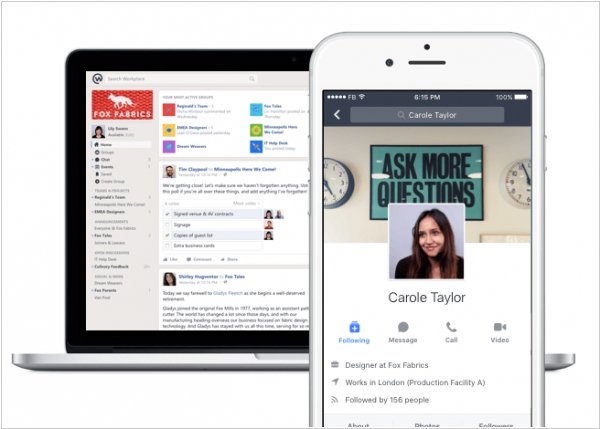
Facebook Workplace, the business-focused version of Facebook, is officially breaking out messaging features into a standalone app for desktop and mobile called Workplace Chat. Now, Workplace users can access messaging features like screen and file sharing, private and group messages, and video calling all in one app. Speaking of video calling, Facebook plans to add group video calling to Workplace's repertoire of messaging features "in the coming months." Facebook Workplace now counts more than 30,000 businesses and organizations using the software. That group, more than double what Workplace claimed six months ago, includes names like Starbucks, Spotify, Lyft, and Walmart.
2017. Microsoft Teams will replace Skype for Business
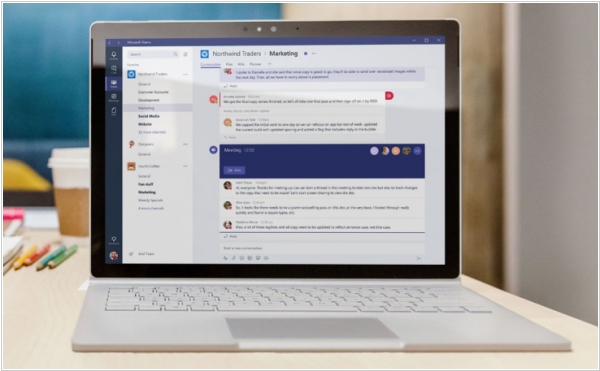
Microsoft announced that its new groupchat Teams will become its core communications platform for users running Office 365. Until now, Skype for Business was the company’s product for this. According to Ron Markezich, the company’s corporate VP for Office 365, Teams will become the “hero and primary experience for all voice, video and meetings.” Over time, Teams will replace the current Skype for Business client. Microsoft obviously knows that enterprises don’t move fast, so for those who don’t want to do away with their existing PBX systems and calling capabilities to the cloud, it’ll launch a new version of the Skype for Business server in 2018. For those who do make the transition to Teams, Microsoft promises lots of new calling features and meeting enhancements with outbound and inbound calls to and from regular phones, support for voicemail, call holding, call transfers and other standard telephony features.
2017. Slack rival Flock released Russian-language version

Flock, a team messenger positioned as an alternative to Slack, has launched a Russian-language version and a local website. With Flock, companies can organize individual or group chats with file sharing and video conferencing capabilities. Each chat (team) receives a URL that anyone can use to join the conversation. Teams can also conduct polls. Flock supports integration with third-party services, including Google products, Trello, Asana, GitHub, IFTTT, Hangouts, and Mailchimp. Flock's main feature is its free version for an unlimited number of users and channels, but with file transfer limits (up to 100 files) and message history retention (30 days). A paid version with unlimited storage starts at $3 per user per month. In conjunction with its launch in Russia, the service provided local users with free access to the premium tariff for the first six months.
2014. Telegram attracts business users
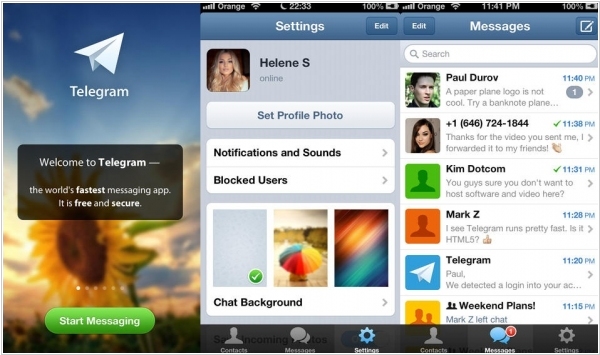
Mobile messaging apps have been rapidly proliferating lately, luring users away from social networks. The same will soon happen in the business sector – corporate Viber apps will replace corporate Facebooks. Telegram (created by VKontakte founder Pavel Durov) initially focused on privacy and security, which is likely why it was the first to be adopted by business users. In a recent interview, Pavel boasted that more and more workgroups are using Telegram for collaboration instead of email. He believes that, in addition to encryption, business users appreciate Telegram's ability to sync messages and files between the mobile and desktop versions, display message statuses (read or not), and organize large group chats.
2006. MyChat - client-server messenger for local network
MyChat is a client-server communications suite for corporate networks. It runs on Windows Me/NT/2000/XP via TCP/IP. Its functionality includes sending/receiving text messages, sending files and SMS, public and secret channels, private conversations, broadcast messaging, a scheduler, a phone book, an address book, and much more. All administrative actions are performed on the server using a graphical interface, a built-in console, or a Telnet session. All transmitted messages can be saved in server logs. Channel and server operator mechanisms are available. Various filters can be configured: for users, flooding, bad words, etc. The server can be managed not only directly but also remotely, using a Telnet session from any operating system.