
Google Cloud Platform
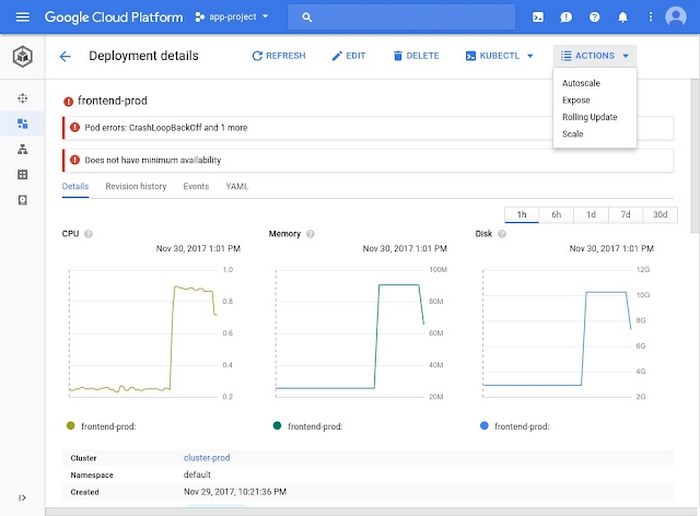
Google Cloud Platform is a set of modular cloud-based services that allow you to create anything from simple websites to complex applications. Cloud Platform provides the building blocks so you can quickly develop everything from simple websites to complex applications. Explore how you can make Cloud Platform work for you.
Add comment
Add comment
Alternatives and relevant products
Users who were interested in Google Cloud Platform, then also viewed:
News about Google Cloud Platform
2021. Google is launching a new generation of its AI chips
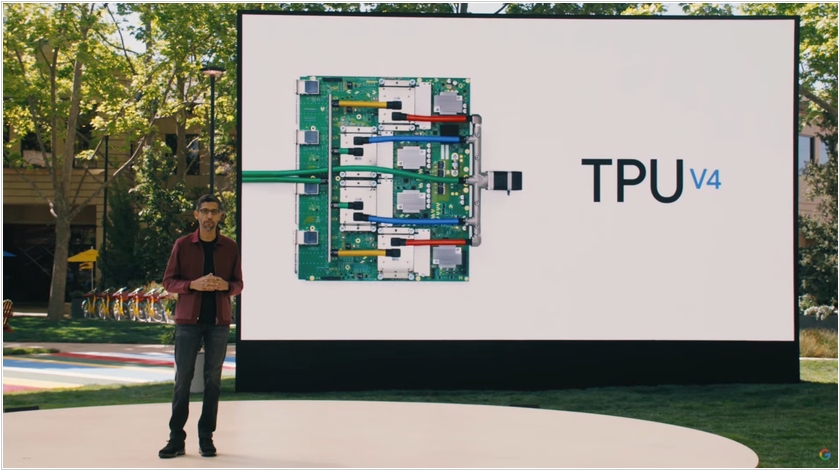
Google unveiled the next generation of its Tensor Processing Units (TPUs) AI chips. This is the fourth generation, and according to Google, it is twice as fast as the previous version. As Google CEO Sundar Pichai noted, these chips are then combined into blocks with 4096 v4 TPUs. A single unit delivers over one exaflop of computing power. Google uses these AI chips to power many of its own machine learning services, but it will also make this latest generation available to developers as part of its Google Cloud platform. While others, including Microsoft, have opted to use more flexible FPGAs for their machine learning services, Google has bet early on on these custom chips. They take a bit longer to develop and quickly become obsolete as technology changes, but they can deliver significantly better performance.
2020. Google Cloud now offers specialized AI services for healthcare
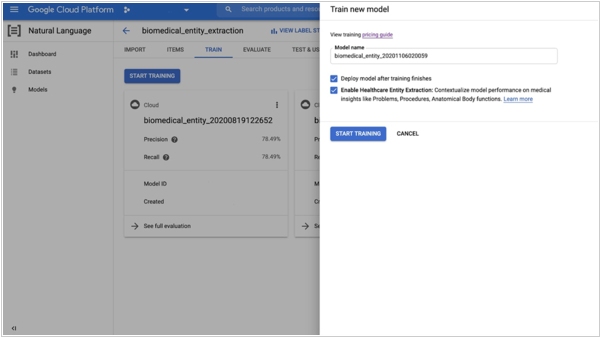
Google has introduced two new cognitive API services on its cloud platform: Healthcare Natural Language API and AutoML Entity Extraction for Healthcare. The first is designed for extracting data from unstructured medical texts/documents. The second is for easily creating machine learning models for extracting named entities from medical documents and patient conversation recordings. Both services provide APIs for integration into healthcare information systems.
2020. Google Colaboratory now has a paid Pro version

Google has introduced a paid version of its neural network training service, Colab Pro, which costs $9.99/month. However, although it is paid, it (like the free version) does not provide guaranteed resources and is not designed for production training and execution of neural network models. However, paid users will still have priority access to fast T4 and P100 GPUs (while users of the standard version will work with K80 video cards). They will also have priority access to TPU tensor processing units. Furthermore, Colab Pro allows for up to 24 hours of connection time, and has relatively relaxed idle time limits. In the free version of Colab, notebooks can run for up to 12 hours, and they disconnect fairly quickly when in standby mode.
2019. Google Offers TensorFlow Enterprise to Businesses
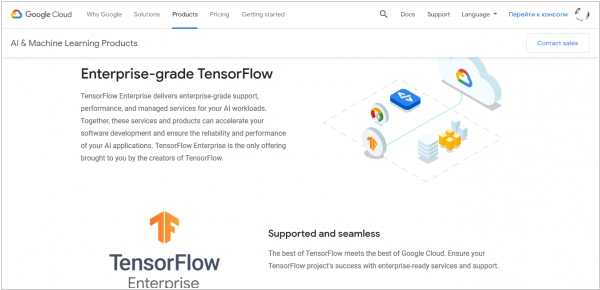
TensorFlow is the most popular machine learning framework developed at Google. It has been open-sourced since 2015, but now Google has decided to capitalize on it and launched TensorFlow Enterprise, which includes extended support and associated cloud services on Google Cloud. This support ensures the continued use of older versions of TensorFlow, which companies have already built their AI models on. In the cloud, Google engineers will help customers quickly launch virtual machines for deep learning neural networks or Kubernetes containers.
2019. Google unveiled its AI Platform cloud service for creating ML models
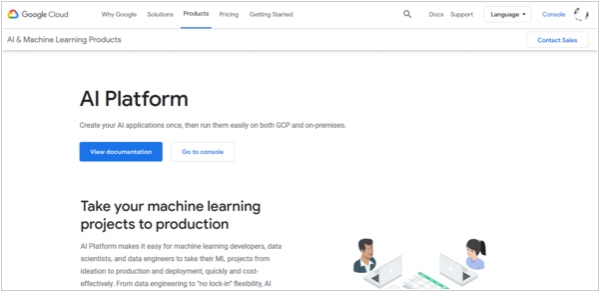
Google has released a beta version of its AI Platform. Users can choose from pre-built data processing algorithms or train and deploy their own model. The platform brings together a variety of existing and new products that together provide a full model development cycle. The AI Platform includes algorithms for data processing and labeling. Most services are paid, but some are free. For example, you can freely use Kuberflow, AI Hub, notebooks, and cloud storage with limitations.
2013. Google Compute Engine is available for all
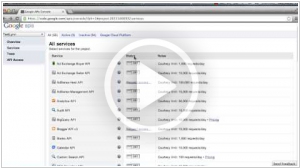
Google launched its cloud IaaS platform Google Compute Engine a year ago, and then we called it the very strong competitor for Amazon Web Services. But the problem was that during this year the platform was available only for selected users (who paid $400/month for Google's Gold-support). Yesterday Google Compute Engine has become available to everyone, so let's get ready to rumble. With the public launch Google has added several new features. In particular, advanced routing - to create gateways and VPN servers, and enable you to build applications that span your local network and Google’s cloud, support for PHP in Google App Engine. Unlike AWS, Google introduced per-minute billing for the virtual servers (instead of per-hour). The pricing starts at $0.02/hour for a shared-core server. The video shows how you can create linux-server with the required parameters in 30 seconds on Google Compute Engine.
2011. Google killed App Engine for Business

Last month, at the Google I/O conference, Google announced changes in GAE pricing, and caused panic among the developers. Without going into details, we'll just say that the developers initially incorrectly calculated the new fees, and only after Google's clarification post, it became clear that the prices would jump, but not so much. However, in the shadow of this panic another small announcement was unnoticed - the enterprise version of Google App Engine, launched a year ago - was closed. This does not mean that Google is no longer positioning its PaaS platform for business. Most of the features of the enterprise version (99.95% SLA, support for SSL, SQL, Spring framework) will be soon implemented in the basic version. However, this means that Google has done a lot of mistakes with the PaaS platform and currently loosing the game in competition with Microsoft, Salesforce, Amazon, VMWare. ***