
Amazon Web Services
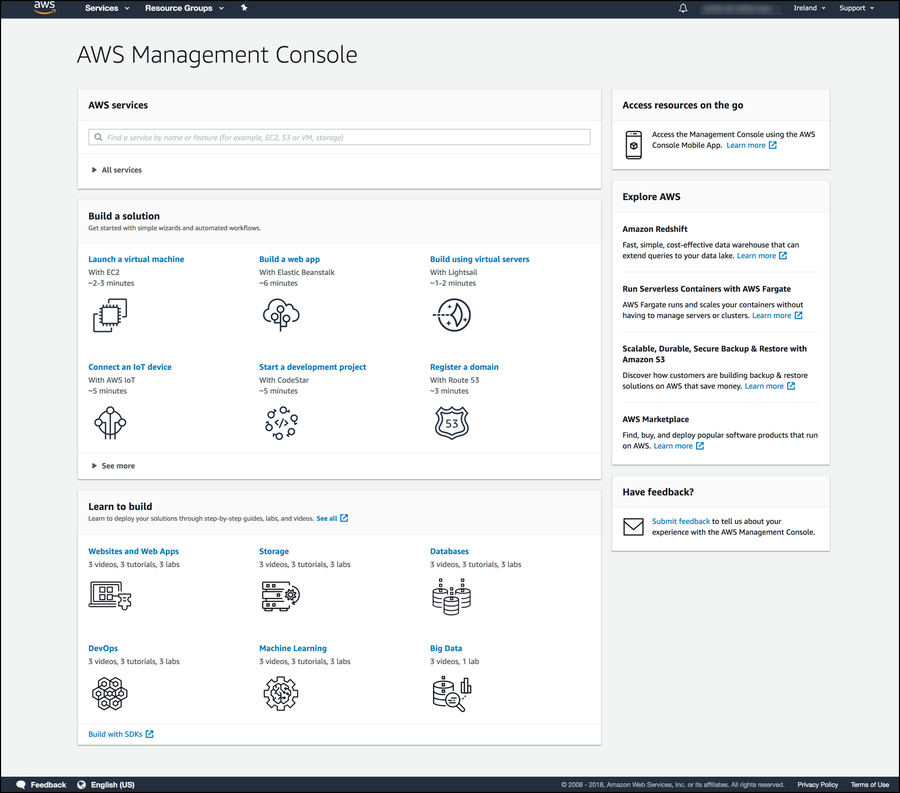
IaaS/PaaS cloud platform with over 200 services, including computing, storage, database engines and machine learning. Provides a global network of data centers and pay-as-you-go pricing model.
Add comment
Add comment
Alternatives and relevant products
Users who were interested in Amazon Web Services, then also viewed:
Video about Amazon Web Services
News about Amazon Web Services
2022. AWS launched service that writes code using natural speech
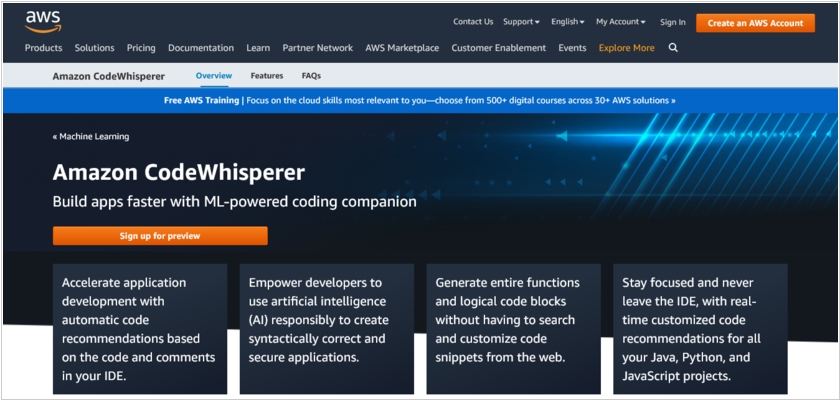
Amazon has launched a cloud service, CodeWhisperer, which uses machine learning to generate suggestions as you write code. The tool is designed to accelerate software development and create training datasets for its artificial intelligence projects. CodeWhisperer was trained on trillions of lines of code from open-source projects, both internal repositories and various other sources. The service can generate more than ten lines of code at a time and bases its recommendations on various contextual cues. Jeff Barr, vice president and chief evangelist at Amazon, explained that CodeWhisperer uses a variety of contextual cues to generate recommendations, including the cursor location, the code preceding the cursor, and code in other files in the same project.
2021. Amazon unveils no-code machine learning service
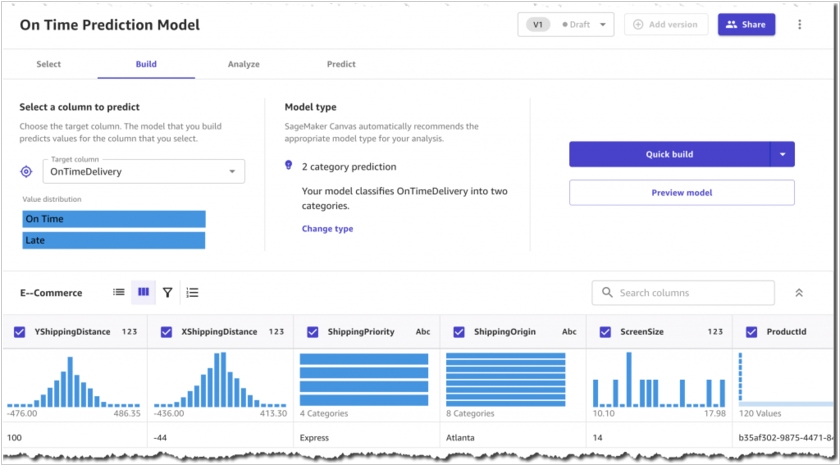
AWS has launched a new machine learning service, Amazon SageMaker Canvas. Unlike existing machine learning services on Amazon, this one is targeted at business users, not data scientists and engineers. SageMaker Canvas promises to enable anyone to build machine learning-based predictive models using a visual interface. Microsoft Azure and other providers also offer similar tools, but AWS's advantage is that many companies already store all their data on AWS.
2021. Amazon Unveils New Machine Learning Chip for AWS
Amazon unveiled the Trn1 chip, specifically designed for deep learning tasks. Observers say this product will directly compete with Nvidia chips. The manufacturer expects training machine learning models using Trn1 to be 40% cheaper than on competing platforms. Instances will offer network throughput of up to 800 Gbps and can be used to form clusters of tens of thousands of systems. Trn1 instances are available in preview. Despite developing its own chips, AWS continues to work closely with Intel, AMD, and Nvidia. Brown stated that his company is making every effort to maintain competition in the segment by offering consumers a choice of processor platforms.
2019. Amazon Cloud Can Now Be Installed in Your Own Data Center
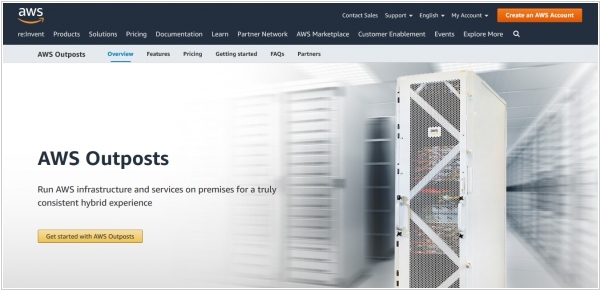
Amazon has launched sales of AWS Outposts, an on-premises version of the world's most popular cloud platform, Amazon Web Services. It is suitable for building private and hybrid clouds for companies that are unwilling to transfer their valuable commercial information to a public cloud, or for factories that require ultra-fast access to applications (even without internet access). The on-premises version of the platform includes EC2, EBS, Virtual Private Cloud, Kubernetes Service, and other modules. S3 storage is not yet available, but it is promised to be added to the build soon. It is worth noting that Amazon was the last of the big three to release its on-premises cloud. Microsoft and Google have been selling their cloud platforms in a box for some time now. They are called Azure Arc and Google Anthos, respectively.
2018. Amazon Launched Blockchain Platform for Business
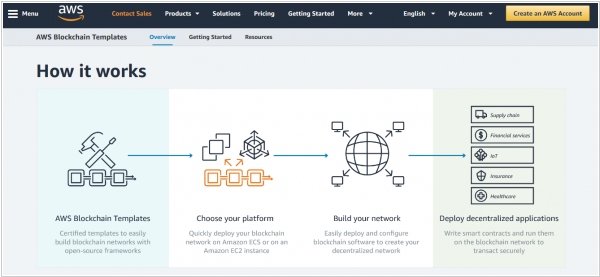
Amazon has launched its own blockchain-as-a-service system, which will compete with similar solutions from IBM, Oracle and Microsoft. It's called Blockchain Templates and runs on the Amazon Web Services cloud platform. As the name suggests, the system allows you to choose one of the ready-made blockchain network templates (Ethereum and Hyperledger Fabric networks are supported), install the server component in the Amazon cloud, and the client components on nodes of the decentralized network, and create smart contracts (for example, for supply chains, financial services, or medicine).
2016. AWS now offers cognitive API services

Amazon has launched three cognitive API services on its Amazon Web Services platform. The first, Rekognition, enables image recognition. You upload images to the platform and receive a list of object names, such as a dog breed. The second, Amazon Polly, converts any text (in 24 languages, including Russian) to speech. You can choose from 47 male and female voices. The third, Lex, is the engine that powers Amazon Alexa, the virtual assistant. It allows you to create chatbots within messaging apps and mobile apps that answer your customers' questions. Integrations with Facebook Messenger, Slack, and Twilio are available from the outset.
2015. Amazon added machine learning service to its cloud platform

Amazon's cloud platform powers numerous applications. To keep these applications up-to-date and smarter, Amazon has added a new service to the platform: Amazon Machine Learning. It enables the use of machine learning algorithms to create models for finding patterns in big data. Last year, IBM launched a platform that allows third-party applications to leverage Watson's artificial intelligence capabilities, but that focused on specific AI functions (such as speech recognition and machine translation). Amazon, however, offers a more general-purpose tool for processing any big data.
2014. Amazon and Microsoft drop cloud prices
Cloud computing is becoming cheaper and cheaper. So, if you once (for example, a year ago) calculated whether it was cost-effective to migrate your IT infrastructure to the cloud and decided that it was still expensive, then recalculate again. Since then, cloud platform reduced prices two or three times. Another round of happening now. Since tomorrow Amazon S3 cloud storage pricing will decrease by 6-22 % (depending on the used space), and the cost of cloud server hard drives (Amazon EBS) will fall by 50%. And a month later Microsoft's cloud platform Windows Azure will reduce its prices by 20% to keep them a little lower than Amazon's. So think once again, why buy an in-house server if the cost of the cloud tends to zero.
2012. Amazon - gets closer to Windows, OpenStack - closer to Linux
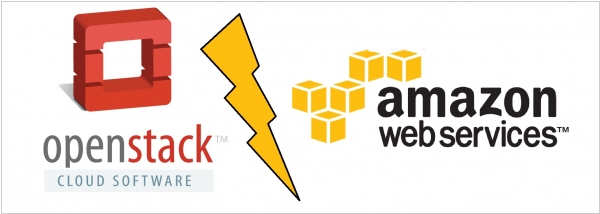
The situation on the cloud (IaaS) platform market more and more reminds us the history of the desktop operating systems (Windows and Linux). On the one hand - open and standard-based platform OpenStack. It's standards this week were supported by two more giants - IBM and Ericsson, that joined the OpenStack alliance. Before them the alliance included Rackspace, Citrix, Intel, AMD, Cisco, Dell, HP. On the other hand - proprietary but already very popular platform Amazon Web Services (AWS). AWS gained it's popularity as a simple and open platform which allows to restore Linux or Windows server and scale it depending on the load. It was relatively easy to move applications of AWS. But as Amazon adds new features to AWS, it lockes clients and partners more and more in its golden cage. ***
2011. Amazon enters PaaS market. Takes on Google, Microsoft and Salesforce
As known, Amazon Web Services - is the leader of IaaS market. It's the service that allows you to rent computing resources for enterprise software or SaaS service hosting. And using it you reserve the required number of servers, configure operating system, install and configure middleware, enable/disable servers depending on the load. This is called IaaS (Infrastructure as a Service). But honestly, IaaS - it's not perfect. In most cases, companies and SaaS providers would not want to handle these servers and other infrastructure themselves. All they want - is that their application worked properly on any load. And they don't care what is under the hood of the cloud platform. This is the primary idea of competing technology - PaaS (Platform as a Service). And it is logical that PaaS platforms are gradually displacing IaaS. ***